
Replace Manual Affordability Assessment Reviews With Lending Intelligence
GoLend turns payslips, bank statements and CDR data into a structured affordability and serviceability report, so your credit team can reach a lending decision with a more accurate view of a borrower's financial position.

Trusted by leading Australian lenders


What Your Bank Statements Aren't Telling You
A bank statement or payslip only shows a single point in time.
Transaction data shows a pattern over time, which is what actually determines whether a borrower can afford a loan.
GoLend adds this layer of visibility to your existing assessment process. It doesn’t replace the other information you hold on a borrower; it adds what a static document leaves out.
From categorised transaction data, GoLend can identify:
- Income
- Fixed and variable expenses
- Debt obligations
- Financial surplus
- Spending behaviour
- Liabilities
- Irregular income patterns
- Relevant risk indicators
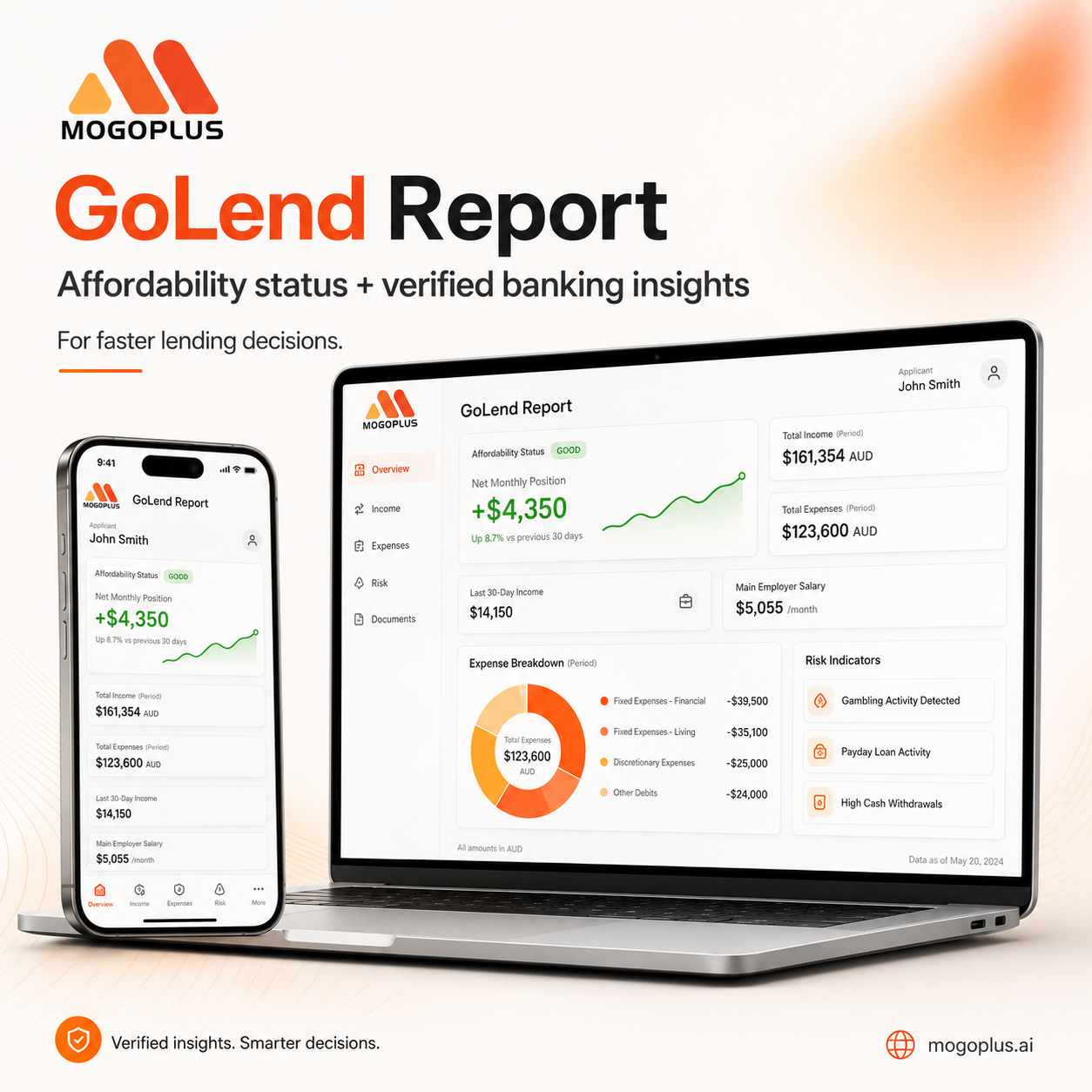
What Your Credit Team Receive in Every GoLend Report
GoLend transforms transaction data into structured affordability and serviceability insights that fit into existing lending workflows.
Each report provides lenders with a clearer view of the borrower’s financial position through:

Affordability Assessment
GoLend measures net income against total expenses, giving your credit team an automatic affordability view instead of a manual, line-by-line calculation.

Serviceability Assessment
The report checks whether a borrower can service the proposed loan at the specific repayment amount, based on their actual income and spending behaviour, not a static total.

Spending Category Breakdown
Transactions are sorted into detailed income and expense categories, so you can see where a borrower’s money comes from and where it goes.

Income Verification
GoLend identifies consistent income patterns across employment types, including regular and irregular income streams.

Risk Flags
The report surfaces financial signals worth a closer look, such as irregular income, undisclosed liabilities, or high-risk spending patterns.

Structured Outputs
Findings are delivered as structured JSON outputs and PDF reports, ready to plug into your existing lending workflow or credit decisioning system.
Open Banking Opens the Door, GoLend Does the Rest
Open Banking and Australia’s Consumer Data Right (CDR) give lenders a secure way to receive a customer’s authorised financial data. That’s access, not analysis.
GoLend takes that data, whether it arrives through Open Banking, a direct file upload, or an existing integration, and turns it into the affordability information of the borrower your credit team actually needs.
How the data flows:
- Customer-authorised financial data
- Open Banking / CDR
- Transaction categorisation
- Financial analysis
- Affordability & serviceability insights
- Lending workflow
From Raw Transactions to a Lending-Ready Report
GoLend follows a structured process to convert transaction data into lending intelligence.
Connect
GoLend receives a borrower’s bank transaction data through Open Banking, direct file upload, or your existing data integration.
Categorise
Every transaction is sorted into income and expense categories, turning a raw list of line items into a structured breakdown.
Analyse
GoLend calculates net income, fixed and variable expenses, debt obligations, and surplus, building a full affordability picture from the categorised data.
Deliver
The finished report reaches you as a structured JSON output or PDF, ready to feed directly into your existing lending workflow or system.
Who GoLend Is Built For
GoLend supports different lending environments by addressing the specific challenges faced by credit teams.
Banks & High-Volume Lenders
Scaling consumer or SME lending puts pressure on your review team. GoLend automates the affordability assessment layer, so approval volume can grow without increasing manual review headcount.
Non-Bank & Established Lenders
If you’re moving away from screen scraping, GoLend offers an API-first, CDR-compliant path to bank data and affordability analysis, without rebuilding your workflow around it.
Credit Analysts
GoLend replaces the routine PDF and bank statement review queue with structured, automated outputs, freeing your time for the applications that genuinely need judgement.
Fintech Lenders
An API-first approach means GoLend fits directly into a AI-led lending product, so affordability and serviceability analysis doesn’t need to be built in-house.
How GoLend Integrates With Your Lending System
GoLend is built to sit inside the lending system you already use.
Most lenders move from first sandbox access to a live production integration in weeks, not months, and without a lengthy procurement process.
Access Sandbox
Get instant access to the GoLend sandbox and run real categorisation and affordability analysis against test data, before writing a line of integration code.
Integrate via API
Connect GoLend to your loan origination system or dashboard, using full API documentation and SDK support.
Go Live in Production
Move from sandbox to live production with a dedicated onboarding engineer supporting the switch.
How to Test GoLend Before You Commit
Start testing our GoLend Affordability Assessment and lending workflow before full implementation.
Before you commit to anything, run GoLend against your own test data. Get full sandbox access, generate real affordability and serviceability reports, and test the API directly, with no credit card required.
When you’re ready to move forward, a dedicated onboarding engineer helps you get to production.

The Old Way vs. The GoLend Way
Manual financial reviews often require credit teams to analyse PDFs, categorise transactions, and interpret borrower behaviour manually. This approach can become difficult to scale as application volumes increase.
GoLend provides transaction-data-based analysis with structured outputs that help credit teams spend less time on routine financial reviews and more time on complex lending assessments.
Transaction-data-based analysis
Structured transaction categorisation
Consistent affordability insights
Designed for lending workflow integration
Supports scalable lending assessment processes
Trusted Within the Australian Lending Ecosystem
Lenders including Westpac, Lendus, Loan Options AI, One Click Life, Arab Bank, and Central Murray Credit Union use GoLend to automate their affordability workflow and reduce time-to-decision.
“With MogoPlus, our credit assessment processes are now producing quicker decisions, more accurate assessments, and a low-friction member experience.”
“By using MogoPlus to optimise credit decisioning, we’re able to automate our ‘Little Money’ cash advance products for customers who can afford to repay them, and give them access to cash when they need it.”
“Combining MogoPlus’s GoLend Affordability Report with our Open Banking APIs lets us offer a best-of-breed data and insights solution through a single integration, for lenders migrating away from screen scraping.”
The Experience Behind Every GoLend Report
2 mins
To first API call
12B+ transactions
Analysed from Tier 1 banks
12+
Years of lending data expertise
Common Questions People Ask
What is GoLend?
GoLend is MogoPlus’s affordability assessment solution. It turns a borrower’s bank transaction data into a structured affordability and serviceability report for lenders.
What does GoLend do?
GoLend analyses a borrower’s transaction data and produces a report covering affordability, serviceability, income verification, spending categories, and risk flags.
How does GoLend assess affordability?
GoLend calculates a borrower’s net income against their total expenses, using categorised transaction data rather than static totals from a document.
What is a GoLend Affordability Report?
It’s the structured output GoLend produces for each borrower, covering affordability, serviceability, spending categories, income verification, and risk flags, delivered as JSON or PDF.
How does GoLend use Open Banking data?
GoLend can receive a borrower’s transaction data through Open Banking, alongside other supported sources such as file upload or existing data integrations, then analyses that data to build its report.
Is GoLend compatible with CDR-compliant Open Banking?
Yes. GoLend accepts Open Banking data made available under Australia’s Consumer Data Right (CDR), giving lenders a CDR-compliant path to affordability analysis.
What financial information does GoLend analyse?
GoLend analyses a borrower’s transaction data, including income, expenses, debt obligations, assets, liabilities, and spending behaviour.
Can GoLend verify income?
Yes. GoLend identifies consistent income patterns across employment types, including regular and irregular income streams.
Can GoLend assess serviceability?
Yes. GoLend checks whether a borrower can service a proposed loan at a specific repayment amount, based on their actual income and expenses.
How does GoLend categorise bank transactions?
GoLend sorts transaction data into income and expense categories, giving a structured view of where a borrower’s money comes from and where it goes.
Can GoLend integrate with an existing lending system?
Yes. GoLend delivers structured JSON outputs and PDF reports designed to plug into an existing loan origination system or credit decisioning workflow.
What outputs does GoLend provide?
GoLend provides an affordability assessment, serviceability outputs, a spending category breakdown, income verification, risk flags, and structured JSON or PDF reports.
How long does it take to integrate GoLend?
Most lenders move from sandbox access to a live production integration in under two weeks, following an initial API integration period of two to five business days.
Who is GoLend designed for?
GoLend is designed for banks, high-volume lenders, non-bank and established lenders, credit analysts, and fintech lenders.
Can lenders test GoLend before implementation?
Yes. Lenders can access a full GoLend sandbox with no credit card required and run affordability reports against their own test data before committing to production.
Bring GoLend Into Your Lending Process
GoLend gives your credit team a decision-ready affordability and serviceability report, built from real transaction data instead of manually reviewed documents.
Run it against your own data, or talk to the team about fitting it into your lending workflow.