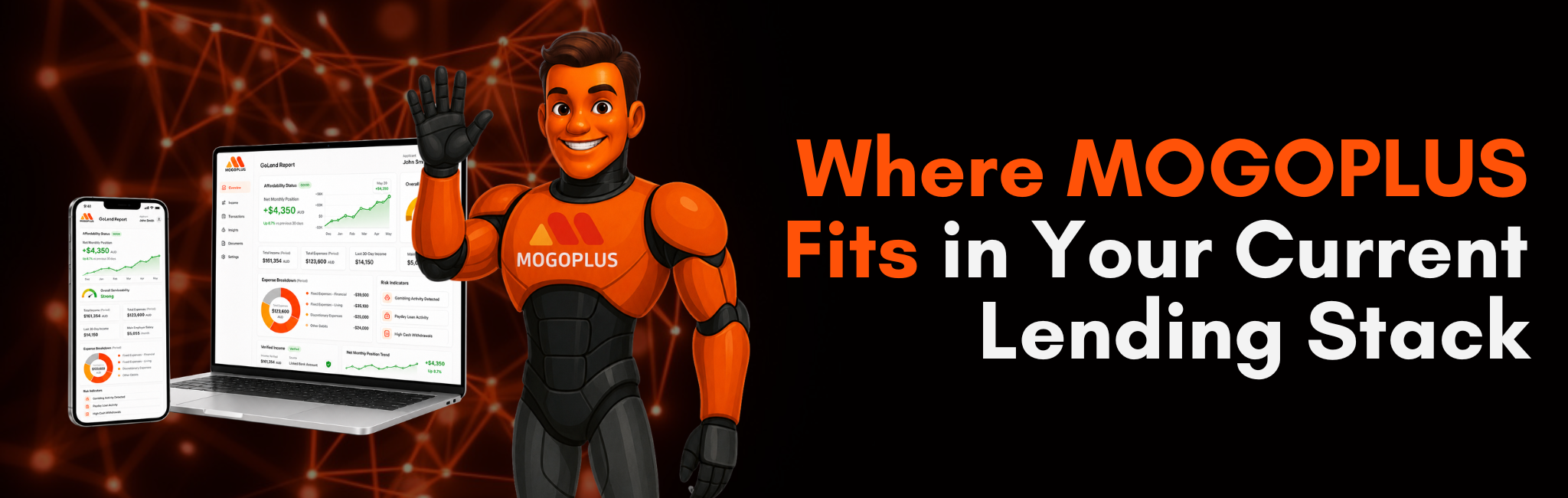
Income and Expense Verification Through Open Banking
Verifying a borrower’s income used to mean chasing 90 days of PDF bank statements, or asking the applicant to hand over their internet-banking login so someone on your team could read the transactions by hand. It’s slow, it’s manual, and it falls apart the moment a borrower doesn’t have a tidy PAYG payslip.
Open banking changes that. But it also raises a fair question for any lender weighing it up: if the data now comes straight from the bank, where does a company like MOGOPLUS actually fit into the workflow? And how is that different from the loan origination platform or processing system you already use?
This post makes the ecosystem role clear, especially for non-bank lenders, credit unions, mutual banks and smaller fintechs that need accurate income and affordability data without buying an enterprise software suite to get it.
THE JOB YOUR LOAN ORIGINATION SYSTEM DOES – AND THE ONE IT DOESN’T.
A loan origination system (LOS) is the digital filing cabinet and workflow manager for a loan. It’s very good at compliance tracking, hosting your CRM, broker messaging, and pushing digital paperwork through to settlement.
It can record that a borrower spent $2,000 on a card last month, but it can’t sift through thousands of lines of unstructured transaction text to work out what that spending really means.
That’s a different discipline – and it’s the one that decides whether an affordability assessment is accurate, and whether a loan is genuinely affordable.
MOGOPLUS IS THE INTELLIGENCE TIER – NOT ANOTHER LOAN PLATFORM.
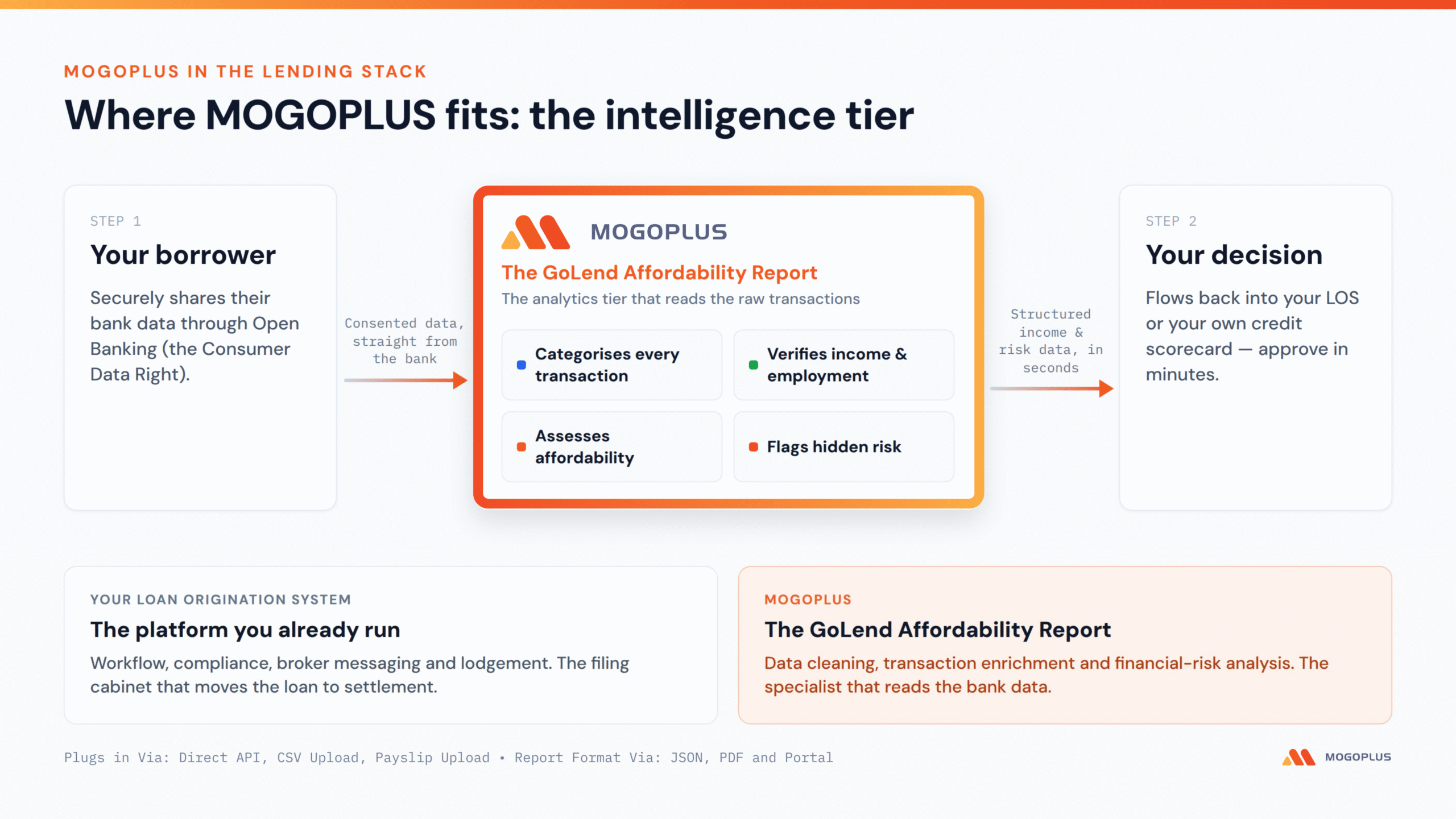
MOGOPLUS does not try to be your loan application portal. It sits behind the scenes as the analytics tier that turns raw, consented transactions into a structured income, expense and affordability picture: The GoLend Affordability Report
The GoLend Report reads the transactions your LOS collects but can’t interpret.
It will:
- Categorises every transaction into a clean income-and-expense dataset, with a lower share of uncategorised transactions – so you get a more complete view of the borrower’s real financial position.
- Verifies income and employment, including irregular, multi-stream and seasonal earnings, by mapping frequency and consistency across months of banking data.
- Assesses affordability from actual day-to-day behaviour rather than a declared number.
- Flags hidden risk – undisclosed commitments such as Buy Now Pay Later instalments and short-term loans that a credit file may never have listed.
That’s the part an origination platform can’t do on its own, and it’s the part that determines credit quality.

WHAT OPEN BANKING CHANGES FOR INCOME AND EMPLOYMENT VERIFICATION.
Under the old model, income and employment verification depended on documents: uploaded PDF statements, or a screen-scraped copy of the borrower’s transactions pulled by logging in with their credentials. Screen scraping is now being phased out under Australia’s Consumer Data Right (CDR).
With open banking, the borrower consents to share their bank data directly through the CDR. The data arrives straight from the bank, which changes three things for verification:
- You can verify real, recurring income rather than trusting a declared figure or a document that’s easy to edit.
- You can handle non-traditional income – freelancers, gig workers, contractors and seasonal earners whose earnings don’t look like a salary line.
- There are no PDFs to doctor. Because the data is pulled from the bank rather than uploaded as a file, income and employment verification rests on a source the applicant can’t quietly alter.
Open banking gives you a cleaner, more trustworthy input. The value then comes from what you do with it.
2 WAYS MOGOPLUS PLUGS INTO YOUR EXISTING WORKFLOW.
MOGOPLUS is built to work with the stack you already have, not replace it. There are 2 easy ways:
1. Direct API into your LOS. MOGOPLUS is architecture-friendly and exposes a suite of modular APIs. A lender using a platform like Nimo or Loanworks embeds MOGOPLUS in the background. When an applicant links their bank account, the raw transaction data flows to MOGOPLUS, which returns a structured income and expense dataset back into the LOS – in seconds – to trigger automated approval logic.
2. Your own tech stack. Many tier-2 lenders, building societies and digital fintechs don’t buy an all-in-one suite – they build their own front end and just need a fast, developer-friendly payload. They plug the GoLend data feed straight into their own credit scorecards.

WHY THIS FITS NON-BANK LENDERS, CREDIT UNIONS AND MUTUAL BANKS.
Enterprise platforms and bureau products are powerful, but they’re often slow to integrate, expensive, and heavy on procurement.
A credit union or a growing fintech shouldn’t have to go through an enterprise buying cycle to get accurate income and expense verification to make fast, accurate lending decisions at scale.
MOGOPLUS is the accessible alternative:
- Fast to integrate and API-first – no rebuild of your loan system.
- Usage-based – you pay per call rather than for a large enterprise licence.
- Platform-agnostic – it works with your LOS, Google marketplace or stand alone use.
- Independent – not owned by a major bank or a credit bureau, so your data infrastructure isn’t sitting inside a competitor.
- Australian-built for the local CDR and credit environment.
THE PRACTICAL OUTCOME: STRAIGHT-THROUGH PROCESSING.
Put MOGOPLUS and your origination platform together and you can safely move toward straight-through processing.
MOGOPLUS handles the financial behavioural analysis working off consented CDR data; your LOS routes that clean data through the legal, compliance and funding pipes.
The result is a genuine income and affordability decision made in minutes rather than days – without adding headcount to your risk team.
FREQUENTLY ASKED QUESTIONS
What is open banking income verification?
It’s confirming a borrower’s income directly from bank data that the borrower has consented to share through the Consumer Data Right, rather than from an uploaded payslip or PDF statement. Because the data comes straight from the bank, it’s harder to manipulate and easier to automate.
Does MOGOPLUS replace my loan origination system?
No. MOGOPLUS is the analytics layer that reads and interprets bank transactions. Your LOS still manages workflow, compliance and lodgement. The two work together – MOGOPLUS feeds clean income and risk data into the platform you already use.
Can it verify income for gig-economy and self-employed borrowers?
Yes. Rather than looking for a single salary line, MOGOPLUS maps irregular income frequencies, seasonal earnings and multiple income streams across months of banking data – the cases where document-based checks usually default to manual review.
Is this suitable for smaller lenders and credit unions?
It’s designed for exactly that audience. It’s API-first, usage-based and platform-agnostic, so you get enterprise-grade income and affordability analysis without an enterprise procurement cycle or a system rebuild.