
Income Verification for Australian Lenders: Why the Document Layer Died & What to Do About It
What Is Income Verification and Why Does It Matter for Australian Lenders?
Income verification is the process a lender uses to confirm that a loan applicant earns what they claim to earn.
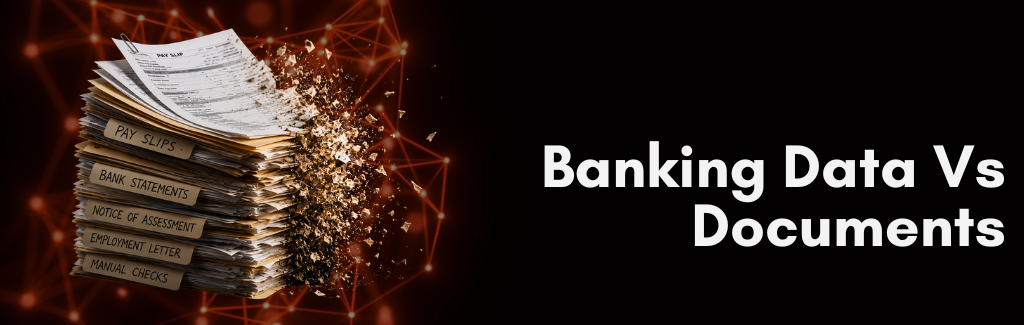
For many Australian lenders, the way to complete this process and determine a lender’s serviceability is to review the familiar stack of physical documents; a payslip, three months of bank statements, a tax return, and a couple of supporting documents.
Now, that model worked when documents were hard to fake.
But thanks to Generative AI, income document forgery has grown from a niche criminal skill into a commodity. A convincing payslip, fabricated tax return, and a doctored bank statement can all be created with one prompt, in seconds without any specialist knowledge required.
For any non-bank lender, BNPL provider, or fintech still relying on manual document review, this is not a future risk. It is a current one, and the data confirms it.
How Bad Is the Mortgage Fraud Problem in Australia Right Now?
Multiple fraud reports document the scale of what is already happening:
- First-party fraud up 25.5% in 2025 (people falsifying their own records)
- Credit fraud up 11.1%
- Synthetic identity fraud jumped by 96.5% as fraudsters used automated tools to submit fabricated profiles at scale
The institutions are already feeling it. Commonwealth Bank self-reported approximately $1 billion in suspect home loans to AUSTRAC and ASIC.
NAB uncovered approximately $150 million in suspected fraud linked to what became known as the Penthouse Syndicate.
And AUSTRAC is now examining home-loan data from at least ten major lenders.
The ABA, MFAA, COBA, AFIA, and Fintech Australia co-signed an open letter to the Treasury requesting consent-based access to ATO Notices of Assessment – because applicant-supplied documents can no longer be trusted as a source of truth.
That is the entire industry acknowledging the same problem simultaneously.
Why Manual Bank Statement Review Is No Longer Sufficient
The average lender fraud team – using manual review and traditional verification processes – detects less than 0.14% of fraudulent documents.
Misrepresentation of financial information accounts for over 95% of fraudulent applications globally. And GenAI tools have made it easy for applicants to fabricate consistent-looking payslips, employment letters, tax returns, and bank statements – all matching each other, all designed to pass a manual review.
What GenAI cannot easily fake (at least not yet) is the underlying ‘transaction layer’.

What Is the Transaction Layer, and Why Is It More Reliable Than Documents?
The transaction layer refers to verified, categorised, consent-based bank transaction data, accessed directly from the financial institution, not supplied by the applicant.
When a fraudster fabricates a payslip, they must also fabricate a bank account that matches it: regular salary deposits on the right cycle, from the right employer entity, alongside a credible pattern of recurring expenses, debt repayments, gym memberships, and everyday spending.
As The Nightly reported in its AUSTRAC coverage:
“falsifying a payslip is the easy part. The hard part is producing a bank account that matches the doctored documents.”
This is why verified transaction data has become the most defensible source of truth a lender has access to.
It is connected, sourced directly from the bank, and indexed against months of real financial behaviour — not minutes of document production.
What Is GoLend and How Does It Work for Income Verification?
GoLend is MogoPlus’s credit intelligence product for non-bank lenders and fintechs.
It ingests raw, unstructured bank transaction data and produces a decision-ready affordability and serviceability report without requiring manual reviews.
The GoLend Report does not rely on applicant-supplied documents. Instead, it works from transaction data to:
- Verify income – confirming actual bank deposits match the claimed income figure, cycle, and employer source
- Calculate true expenses – identifying living costs, recurring obligations, and hidden liabilities automatically
- Detect circular transfers and staged deposits – patterns designed to inflate the appearance of income
- Deliver a serviceability forecast – a structured, audit-ready output that satisfies ASIC RG 209’s “reasonable steps to verify” requirement
The result: accurate, decision-ready credit insight layer that reaches the underwriter with the verification already done.
What Does ASIC Actually Require for Income Verification?
Under ASIC Regulatory Guide 209 (RG 209), lenders are required to take “reasonable steps to verify“ a consumer’s financial situation before approving a credit contract.
AFCA explicitly considers whether inquiries and verification steps were reasonable when assessing responsible-lending complaints. In practice, this means having an auditable record of how income and expenses were verified – not simply a copy of the documents submitted by the applicant.
A manual document review process, particularly one that fails to detect GenAI-altered PDFs, is increasingly difficult to defend as “reasonable” under this standard.
Automated transaction-level verification produces a structured audit trail of exactly what data was reviewed, what patterns were detected, and what conclusions were drawn. That is the kind of evidence ASIC and AFCA want to see.
How Can Non-Bank Lenders Grow Loan Volumes Safely and Quickly?
Growing loan volumes without growing fraud exposure or headcount requires moving from a document-dependent model to a data-dependent one. Here is a practical framework.
1. Replace Manual PDF Review with Automated Transaction Insights
Every hour a credit analyst spends reading bank statements is an hour not spent on credit decisions that require human judgement.
The GoLend Report replaces the manual verification workflow entirely, delivering structured income and expense outputs in seconds, not hours.
The direct impact: faster time-to-yes, lower cost per decision, and a review process that actually detects fraud rather than assuming documents are genuine.
2. Move to CDR-Sourced Bank Data Before the Deadline Forces You
The Consumer Data Right (CDR) rolls out to non-bank lenders from July 2026. Screen scraping (the legacy method most lenders currently use to access bank data) is already being phased out by major providers.
The lenders who migrate to CDR-sourced data first will future-proof their loan book and avoid consent flow friction caused by frequent updates to internal systems.
3. Use Transaction Data to See Applicants That Bureau Data Misses
Traditional credit data fails non-traditional earners: gig workers, contractors, self-employed borrowers, and anyone with irregular income.
A credit analyst reviewing three months of payslips from these applicants will often see insufficient evidence and decline them, even when the borrower is financially sound.
Categorised transaction data sees the complete picture: the sum of all deposits, the pattern of expenses, the stability of income over time, and the genuine serviceability position. For non-bank lenders, this represents a significant addressable market of creditworthy borrowers that bank lenders are systematically underserving.
4. Audit Your Existing Decision Stack for Document Dependency
Most non-bank lenders have layered fraud controls on top of a document-based foundation: identity verification, AML monitoring, transaction monitoring. These are downstream controls. They confirm that the person submitting is who they say they are, or that money flowing after approval looks normal.
None of them verify whether the income, expenses, and liabilities used to make the original credit decision were real.
Auditing your decisioning stack for this gap – and replacing the document foundation with verified transaction data – makes every downstream control more effective. You are no longer catching real people committing fraud that your credit decisioning approved at the front door.
Frequently Asked Questions: Income Verification for Australian Lenders
What is the difference between income verification and income categorisation?
Income verification confirms that an applicant’s claimed income is genuine by cross-referencing transaction data against stated figures. Income categorisation labels individual bank transactions by type (salary, freelance, government payments, etc.) to build a complete picture of income sources and patterns.
Is manual bank statement review still compliant under ASIC RG 209?
ASIC RG 209 requires “reasonable steps to verify” a borrower’s financial situation. Given that specialist tools now detect fraud at a rate 40 times higher than average lender processes, manual review that relies on applicant-supplied documents is increasingly difficult to characterise as a reasonable verification standard. AFCA will assess whether verification steps were reasonable in the event of a complaint.
How does CDR income verification differ from screen scraping?
CDR retrieves bank data directly from the financial institution with explicit borrower consent, via an accredited data recipient. Screen scraping simulates a user login to retrieve data without a formal consent structure. CDR data is cleaner, more reliable, and consent-based. Screen scraping is being phased out by major banks and is no longer the default method for accredited providers such as Frollo.
Can GoLend detect circular transfers and staged deposits?
Yes.
GoLend analyses the pattern of transactions over time, not just individual entries.
Circular transfers (funds moved between accounts to inflate deposit totals) and staged deposits (large pre-application deposits designed to simulate savings) produce transaction signatures that categorised analysis identifies as anomalous.
What does a non-bank lender need to integrate GoLend?
GoLend is an API-first product.
Integration requires an API connection to your existing loan origination or decision system. MogoPlus provides documentation and implementation support. For lenders who also need CDR data access, the Wych + MogoPlus combination provides both layers – open banking retrieval and credit intelligence – through a single commercial relationship.
Is GoLend suitable for high-volume, fast-turnaround decisions like BNPL?
Yes.
Automated transaction-level affordability assessment is the only operationally viable approach to satisfying ASIC’s responsible-lending requirements at BNPL scale. Manual document review cannot execute thousands of decisions per hour. GoLend is designed for high-volume decision environments.
MogoPlus is an Australian data categorisation and enrichment platform. The GoLend Report provides income verification, affordability analysis, and credit decisioning for non-bank lenders, fintechs, and BNPL providers across Australia.
Sources
2026 Equifax Fraud Index Report; Fortiro, “Perspective: Liar Loans, Responsible Lending and Document Fraud”, 4 April 2025; The Nightly, 20 March 2026; FICO Consumer Fraud Survey 2024–25; ASIC Regulatory Guide 209; NextGen via Broker Daily; ACSISS, “Why 2026 is the year to finally embrace CDR”, February 2026; Gilbert + Tobin, ASIC RG 281 guidance, July 2025.