
AI Credit Decisioning in Australia: Ben Ford on Cutting Loan Assessment Times From Hours to Minutes
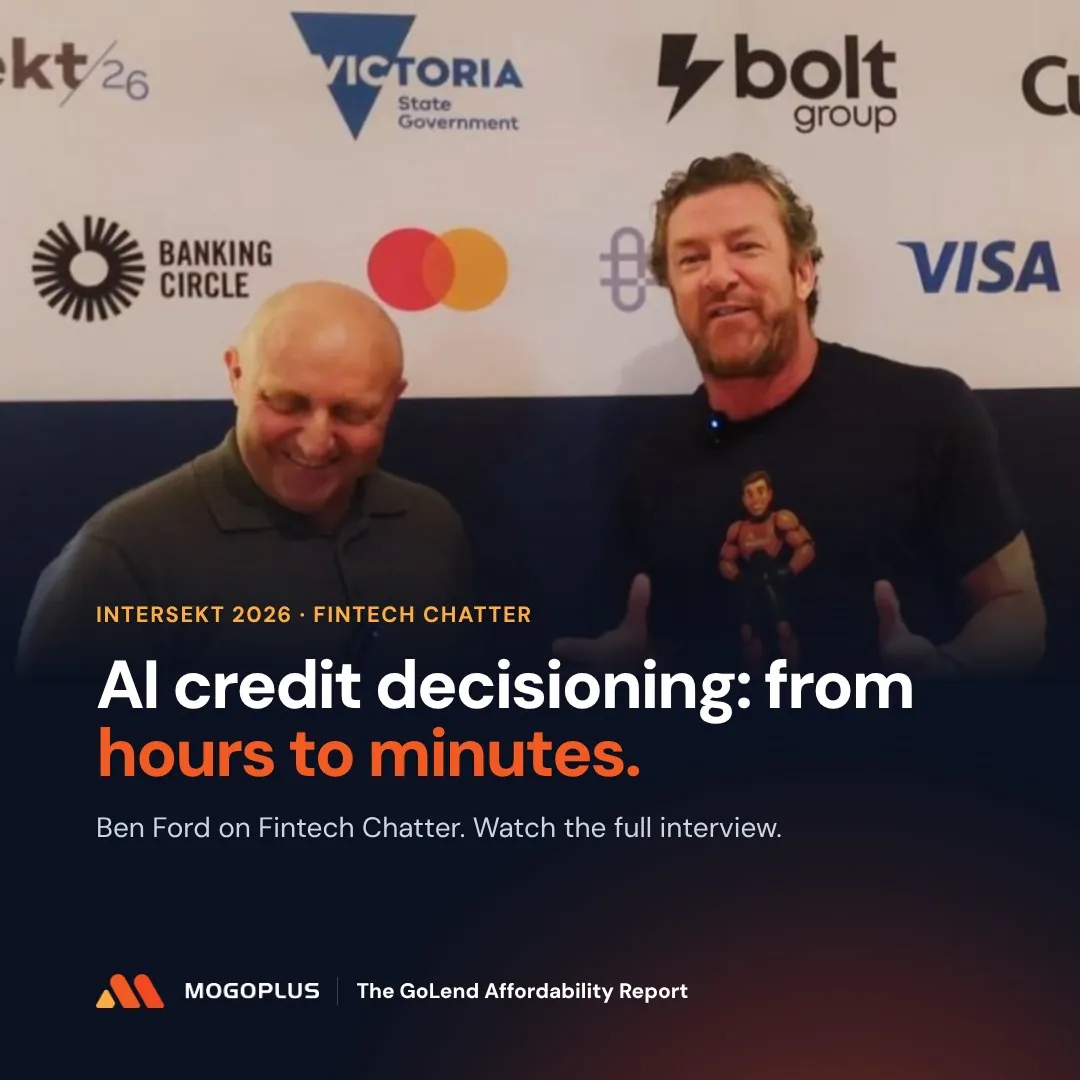
In short: Some Australian lenders still have credit teams reading bank statements with highlighter pens, and it takes them six to seven hours per decision. With open banking data and automated, AI-driven analysis, the same decision can take six or seven minutes. That was the core message from MOGOPLUS Chief Revenue Officer Ben Ford in his conversation with Dexter Cousins on Fintech Chatter at Intersekt 2026.
Prefer audio? Listen on Apple Podcasts.
KEY TAKEAWAYS
- The highlighter-pen credit room still exists. Many lenders automate, but some still review bank statements by hand.
- 6–7 hours vs 6–7 minutes. That’s the gap between manual review and open banking plus automation, per Ben.
- The data source isn’t the problem. Payslips, bank statements, open banking or screen-scraped data can all feed an automated decision.
- CDR finally has momentum. New, simpler ways of sharing data were a talking point at Intersekt.
- CDR isn’t an acronym. It’s about helping consumers get better financial outcomes.
WHAT IS AI CREDIT DECISIONING?
AI credit decisioning is the use of automated analysis, including machine learning, to turn a borrower’s financial data into a lending recommendation. Instead of an analyst reading statements line by line, software categorises every transaction, identifies income and expenses, flags risk signals and calculates affordability in seconds. The lender’s credit policy and people still make the final call. They just make it with a complete, consistent picture, much faster.
WHO IS BEN FORD?
Ben Ford is Chief Revenue Officer at MOGOPLUS, an Australian lending data and insights business that works with banks, mutual banks and fintech lenders.
As Ben put it: “We help them make faster lending decisions to get money in the hands of people who need it more quickly. That’s all we do.”
5 THINGS BEN FORD TOLD FINTECH CHATTER ABOUT AUSTRALIAN LENDING
1. The highlighter-pen credit room still exists
“A lot of banks automate these processes. A lot of fintechs really efficiently automate these processes, but there are also the lenders who still have a couple of people in a credit room going through bank statements with highlighter pens… different colour pencils for different transactions, and that’s how they make their lending decisions.”
Manual review is slow, inconsistent and hard to scale. In an era of scams and fraud, it also leaves room for doctored documents to slip through.
2. Six or seven hours vs six or seven minutes
Ben’s estimate: a manual review takes “about six or seven hours,” whereas “with open banking data and automating that process they can make a decision in six or seven minutes.”
“That’s still the main kernel of the use case for CDR open banking,” he said. For lenders, time to decision is time to revenue. The lender who says yes first usually wins the customer.
3. The data source isn't the problem
MOGOPLUS works with payslips, bank statements, open banking data and screen-scraped data. “We don’t care,” Ben said. “Send us the data. We’ll crunch the numbers. We’ll run the insights and analytics on it in a few seconds and give you back a report so you can make a lending decision.”
That’s the job of The GoLend Affordability Report: one consistent, lending-ready output, whatever the source.
4. CDR finally has momentum
“We’ve been saying it’s gaining momentum for years and years. I think probably the last couple of years have actually been pretty good despite all the naysayers.” Ben pointed to new ways of sharing data discussed at Intersekt that could make it “much easier for people to deliver open banking to their consumers,” without the onerous accreditation process.
“I don’t want to say silver bullet, because we’ve been here before… but I really think this could be pivotal for open banking in Australia.”
5. CDR isn't an acronym
Ben’s hot take: “It’s not an acronym, a bunch of letters and a piece of legislation. It’s actually helping consumers achieve better financial outcomes.”
He argued Australia got “so mired in this legislative process instead of doing it really simply,” and pointed to Plaid in the US as an example of data portability that helps consumers make better decisions. “That’s what we need to move towards in Australia.”
HOW THE GOLEND AFFORDABILITY REPORT SUPPORTS AI CREDIT DECISIONING
The GoLend Affordability Report turns raw bank transaction data into a lending-ready affordability and serviceability assessment. It’s built for Australian banks, mutuals, credit unions and fintech lenders that want to replace manual statement review.
- Every transaction categorised: income, expenses, debts, surplus and spending patterns, so assessors see the borrower’s true financial position.
- Risk signals flagged: the spending patterns and red flags that matter for responsible lending.
- Any data source: open banking (CDR), file uploads or existing integrations.
- Built for decisioning systems: results arrive as structured JSON for your decision engine, or as a PDF for your assessors.
- Fast to start: sandbox access in 0–48 hours and production go-live in under two weeks.
FREQUENTLY ASKED QUESTIONS
What is AI credit decisioning?
AI credit decisioning uses automated analysis of a borrower’s financial data, such as categorised bank transactions, to produce an affordability assessment and lending recommendation in seconds. The lender’s credit policy and team still make the final decision.
How long does a manual affordability assessment take?
According to MOGOPLUS CRO Ben Ford, a manual review of bank statements can take six to seven hours per decision. With open banking data and automation, it can take six to seven minutes.
What data does The GoLend Affordability Report use?
It works with open banking (CDR) data, uploaded bank statements and existing data integrations, and returns a consistent affordability and serviceability report.
Does AI credit decisioning replace credit assessors?
No. It removes the manual work of reading and categorising transactions, so assessors can focus on judgement, exceptions and customer conversations.
Where can I watch Ben Ford's Intersekt 2026 interview?
Watch the full six-minute Fintech Chatter interview with Dexter Cousins above, or listen on Apple Podcasts.
Still reading statements with highlighters? Try The GoLend Affordability Report with three complete income verification and affordability reports, free. No credit card required.
Related reading: Income Verification for Australian Lenders: Why the Document Layer Died · Income and Expense Verification Through Open Banking